Active listening techniques that work in real conversations


In this article
The active listening techniques that work in real conversations are paraphrasing, asking open questions, reflecting feelings without assuming them, clarifying ambiguous details, and confirming next steps. Listen to understand before you respond; then check that your understanding matches what the other person meant.
- Active listening techniques work when you check understanding instead of preparing your reply.
- Paraphrasing and open questions support clearer workplace communication; neither replaces giving someone room to speak.
- Omi supports conversation capture and follow-up, not the human work of listening.
- For your 2026 listening practice, focus on accurate understanding rather than polished responses.
Which active listening techniques work in real conversations?
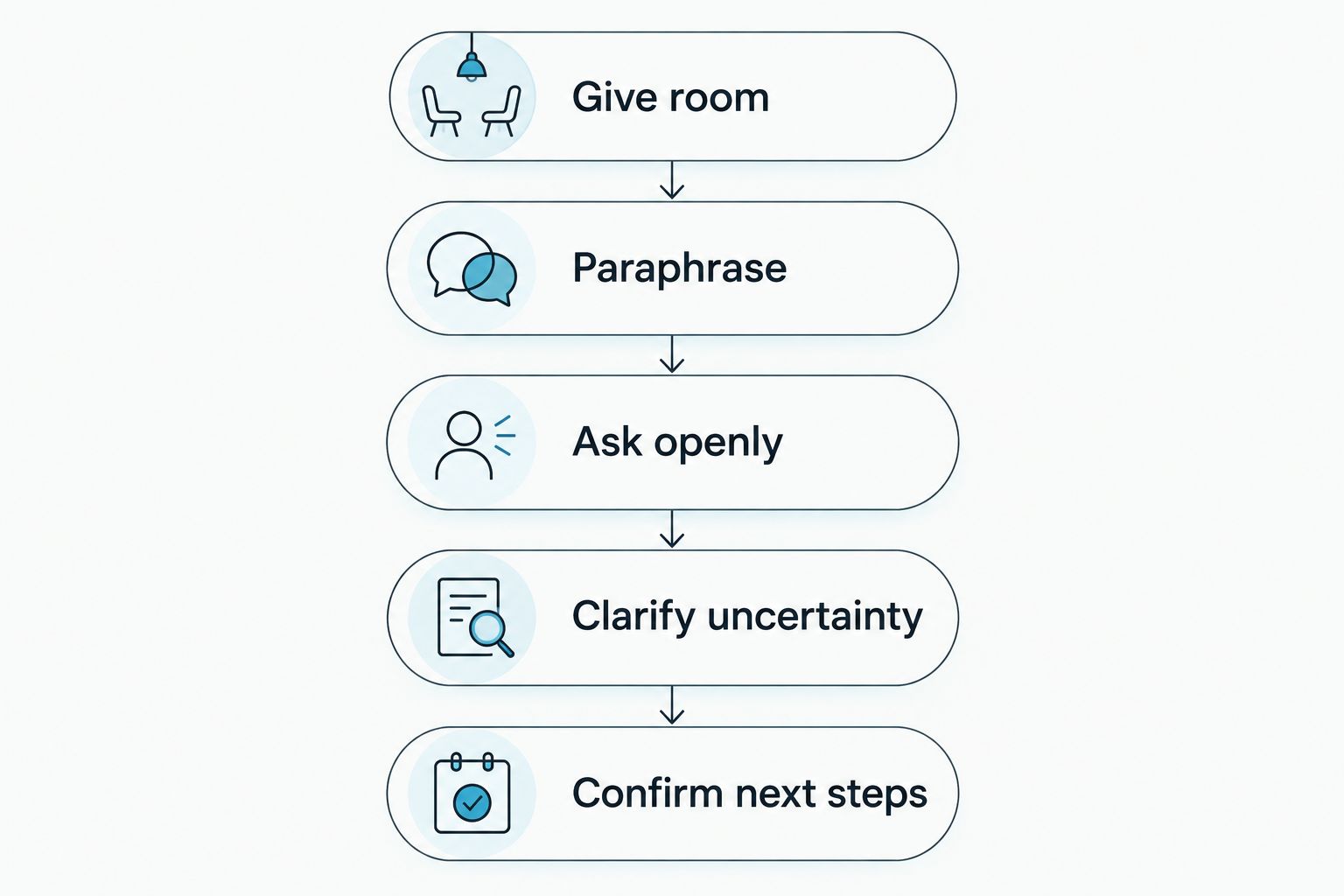
Use a repeatable sequence: give the speaker room, reflect the main point, ask about what remains unclear, and confirm what happens next. You do not need to perform every technique every time. Choose the move that addresses the actual gap in understanding.
Keep listening separate from documentation. These note-taking methods help you organize what you capture, but organized notes do not prove that you understood the speaker.
A practical listening sequence
- Give the speaker room. Let the person complete the thought before introducing your explanation. If you interrupt, acknowledge it and return the floor rather than finishing the sentence for them.
- Paraphrase the main point. Restate the meaning in your own words, not every detail. Use a short summary the speaker can confirm or correct.
- Ask an open question. Explore what matters, what happened, or what the person needs. Avoid stacking several questions into a single turn.
- Clarify the uncertainty. Check names, responsibilities, timing, and words that carry different meanings. Do not quietly fill the gaps with your preferred interpretation.
- Confirm the next step. Summarize the agreement and identify who is responsible. If the conversation needs no action, confirm the understanding instead of inventing a task.
The sequence is a guide, not a script. If someone corrects your paraphrase, stay with the correction. Moving mechanically to the next question defeats the point.
Choose the technique that fits the gap
| Technique | Best for | What it helps you do | Limitation to watch |
|---|---|---|---|
| Paraphrasing | Checking the main message | Make your interpretation visible | A summary can flatten important nuance |
| Open questions | Exploring an unfamiliar situation | Hear the speaker's explanation | A broad question can lose focus |
| Reflecting feelings | Acknowledging a difficult experience | Invite the speaker to clarify their feelings | Naming an emotion as fact becomes an assumption |
| Clarifying questions | Resolving an ambiguous detail | Establish a shared meaning | Too many interruptions break the speaker's flow |
| Pausing | Giving someone room to finish | Avoid rushing into a response | Unexplained silence can feel disengaged |
| Confirming next steps | Closing an action-focused conversation | Separate agreement from assumption | Not every conversation needs a solution |
The best technique is the one that makes your understanding easier to correct. A fluent response that leaves the speaker misunderstood is still a failed response.
Why this matters
Listening is not the same as waiting quietly. You can remain silent while building a rebuttal, planning advice, or deciding what the speaker must mean. Active listening makes those interpretations available for correction.
In your 2026 conversations, judge the habit by what happens after your response: can the other person confirm, refine, or reject your understanding? That is a better practice target than sounding empathetic on command.
You also need a boundary between understanding and agreement. Accurately reflecting someone's position does not require endorsing it. You can understand the concern and still disagree with the proposed solution.
Paraphrasing: check the meaning, not your memory
Paraphrasing works best when you restate the central point and leave room for correction. Keep your first attempt to 1 sentence as a practice constraint, not a rule about how long everyone should speak.
Example response: The main problem is that priorities changed after you had already committed to the deadline. Have I understood that correctly?
This response identifies a possible meaning without claiming certainty. The speaker can correct the priority issue, the deadline issue, or both. That correction is useful information, not an objection to your listening.
Avoid repeating the speaker's words mechanically. Also avoid replacing their explanation with your diagnosis. If someone describes a scheduling problem, calling it poor time management introduces a judgment they did not necessarily make.
Best for: checking understanding before a decision, disagreement, or handoff. The limitation is compression: after the summary, ask whether you left out anything important.
Open questions: explore without steering
An open question invites an explanation rather than a yes-or-no answer. Ask about the situation before proposing a cause. Your goal is to hear information you have not already decided to expect.
Useful sample prompts include:
- What changed after the original plan?
- Which part is hardest to manage?
- What would a useful outcome look like?
Compare that with asking whether someone failed to communicate early enough. The second approach embeds a verdict inside a question. Even if communication was part of the problem, start by establishing what happened.
Ask 1 question at a time. A long bundle about causes, feelings, deadlines, and solutions gives the speaker several possible starting points and makes the answer harder to follow.
Best for: discovering the speaker's priorities or understanding an unfamiliar problem. The limitation is scope: once you identify the relevant issue, narrow the question rather than continuing to explore everything.
Reflecting feelings: acknowledge without diagnosing
Reflecting feelings means checking the emotional meaning of what someone described. It does not mean naming an emotion as an established fact or claiming to know exactly how they feel.
Example response: That sounds frustrating, especially after you had already raised the concern. Is frustration the right word?
The final question matters. The person might be worried, disappointed, embarrassed, or simply tired. Let them choose the description instead of treating your vocabulary as their experience.
You can also acknowledge the situation without labeling a feeling. Recognizing that someone received conflicting instructions can be more useful than guessing their emotional state.
Best for: conversations where the speaker emphasizes the effect of an experience, not just the events. The limitation is overinterpretation. Stay close to what the person actually said and accept corrections immediately.
Clarifying questions: replace vague agreement with shared meaning
Words such as urgent, finished, supported, and soon leave room for different interpretations. Clarifying questions turn those words into an understanding you can both use.
Example response: When you say the handoff is finished, does that include the supporting notes, or only the main document?
Use clarification when the answer changes a decision or commitment. You do not need to interrupt for every unfamiliar detail. Let the speaker finish when the uncertainty can wait.
For a 2026 listening practice, look specifically for vague commitments in your own summaries. If your closing statement still depends on an undefined word, ask about it before treating the conversation as settled.
Best for: responsibilities, deadlines, scope, and instructions. The limitation is interrogation: explain why the detail matters, especially when you need several clarifications.
Pausing and summarizing: stop rushing the ending
A pause gives the speaker an opportunity to continue. It also gives you space to separate what they said from the response you were preparing. There is no universal silence length that proves you are listening.
Stay visibly engaged in a way that fits the person and setting. Do not treat eye contact, stillness, or a particular posture as a universal test of attention. Ask about communication preferences when those preferences matter.
Before closing an action-focused conversation, check 3 details: the action, the owner, and the timing. These are a practical checklist, not a claim that every conversation requires a deadline.
Summarizing has a downside: it can sound like you are closing the discussion before the speaker is finished. Ask whether anything remains unresolved. If the person wanted to be heard rather than assigned a solution, acknowledge that instead.
Why active listening varies by conversation
Active listening changes with the purpose and conditions of the exchange. Use these factors to choose your approach rather than applying the same sequence everywhere:
- Purpose: A technical handoff needs precise clarification. A personal concern can need acknowledgment before discussion of solutions.
- Emotional intensity: When someone is describing distress or anger, establish what they mean before debating the conclusion.
- Power differences: A colleague speaking to a manager needs a genuine opportunity to disagree with the manager's summary.
- Language and terminology: Check unfamiliar terms and expressions instead of assuming shared meaning.
- Setting: Noise, interruptions, and competing tasks affect what you hear. Address the environment rather than compensating with more questions.
- Communication preferences: Give the person room to explain how they prefer to discuss, process, or confirm information.
For workplace conversations in 2026, make correction explicit. Invite disagreement with your summary, then demonstrate that correcting you does not derail the conversation.
How do you listen actively when you disagree?
Start with 1 sentence that fairly states the other person's position, then ask whether it is accurate. Explain your disagreement only after the person has had a chance to correct your understanding.
Keep the concern separate from the proposed solution. You can recognize a legitimate workload problem without agreeing that a particular deadline should move.
How do you stop giving advice too quickly?
Ask 1 question about what the speaker wants from you: listening, help thinking through options, or a recommendation. Then respect the answer instead of treating every concern as a request for a fix.
If you have already jumped into advice, acknowledge the jump and return to their explanation. A brief repair is more useful than defending your intention to help.
How do you turn listening into reliable follow-up?
Confirm 3 details: the action, the owner, and the timing before you close an action-focused conversation. Put unresolved issues separately so that your notes do not turn uncertainty into agreement.
Omi is best for professionals who want conversation transcripts and follow-up tasks. The Omi wearable and companion app capture conversations and produce transcripts, summaries, action items, and memories. That supports remembering what was discussed; it does not establish that your interpretation is correct.
Use Omi conversation notes after the exchange to check names, commitments, and unresolved points. Verify the output before treating it as a final record. For multilingual conversations, Omi supports 33 languages, but you must select the language manually; it does not automatically switch languages mid-conversation.
Recording also creates a separate responsibility. Consent rules vary by location, so check local law and follow applicable workplace requirements before recording. A recording is not permission to ignore someone's preferences.
FAQ
What are the best active listening techniques for everyday conversations?
Paraphrasing, open questions, clarification, and confirming understanding are practical starting points. Choose the technique that addresses the uncertainty instead of using every technique in every exchange.
How can I show I am listening without repeating everything?
Summarize the main meaning in your own words and invite correction. You do not need to repeat each detail to demonstrate attention.
Is active listening the same as agreeing with someone?
No, active listening means understanding someone's position accurately, not endorsing it. Confirm the meaning before explaining where you disagree.
What should I do if someone says I misunderstood them?
Accept the correction and ask what your summary missed. Restate the corrected meaning instead of defending your original interpretation.
Can conversation recording replace active listening?
No, recording preserves audio but does not check your understanding with the speaker. You still need to clarify ambiguity and confirm agreements during the conversation.
How can I practice active listening at work in 2026?
Choose a conversation and focus on paraphrasing before responding. Afterward, review whether you invited correction and distinguished confirmed actions from unresolved issues.
Should I always ask questions when someone is upset?
No, give the person room to speak before asking for more detail. Use questions to clarify their meaning, not to force an explanation or rush toward a solution.
One last thing
A correction is a useful listening outcome. If someone tells you that your summary missed the point, your check exposed a misunderstanding before it became a decision or commitment.
For your next conversation, choose one habit: paraphrase before giving your opinion. Do not measure success by whether your first summary was right. Look for whether the speaker had a real opportunity to make it right.