How to be more present in conversations


In this article
To be more present in conversations, put distractions out of reach, listen for the other person's meaning, and check your understanding before offering a response. When your attention drifts, return to their last point instead of criticizing yourself or pretending you heard it; the goal is to keep returning, not to achieve perfect concentration.
- Learning how to be more present starts with fewer distractions, active listening, and checking what you heard.
- Ask whether someone wants advice before trying to solve their problem.
- Omi supports conversation capture and follow-up; recording never replaces attention or permission.
- Choose a note-taking method that fits the conversation, not just your preference for keeping records.
How to be more present in conversations
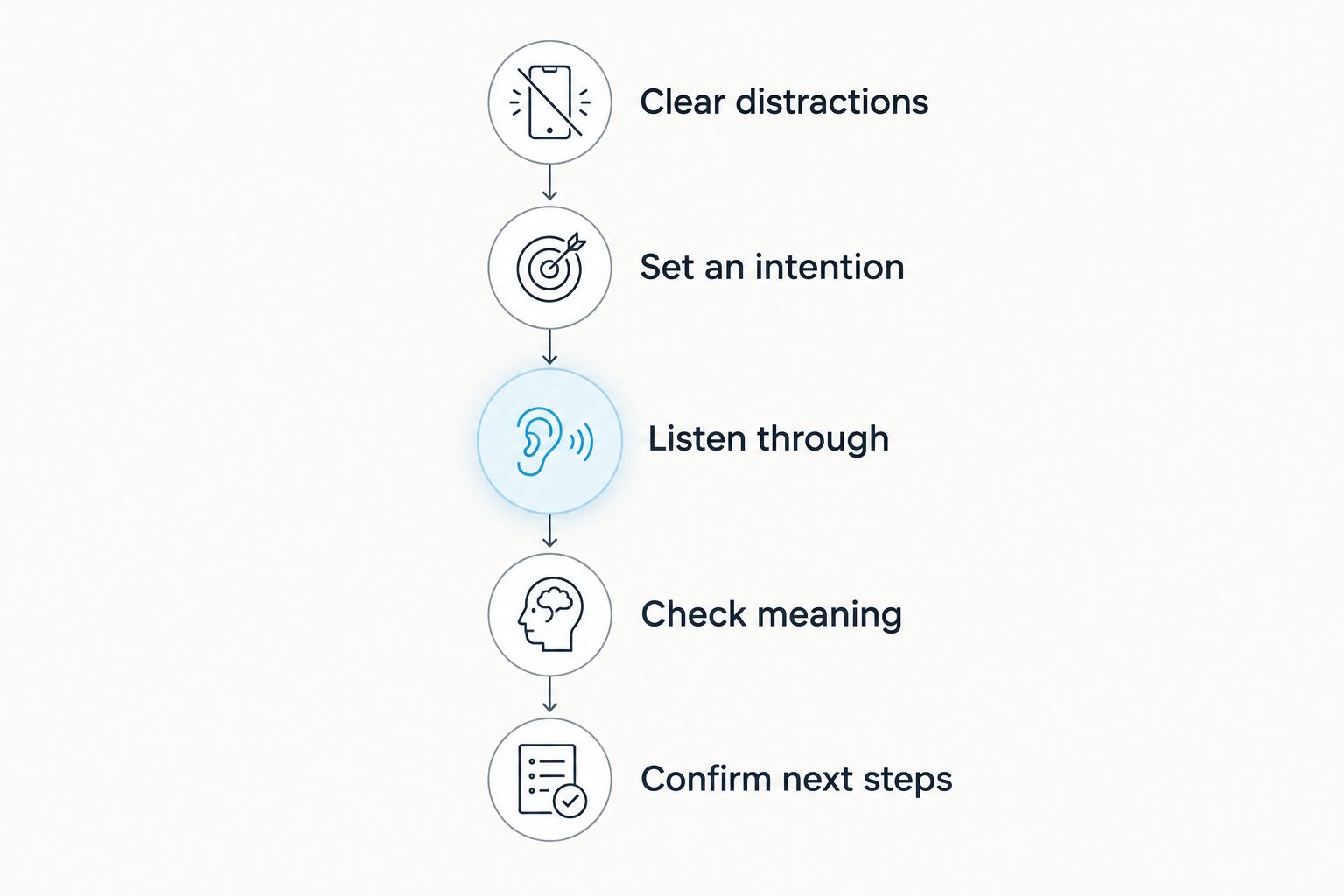
Listen to understand the point before preparing your reply. Start with the sequence below, then adjust your note-taking habits to match the situation. For specific ways to reflect and clarify what someone says, use these active listening techniques.
- Clear distractions. Put your phone out of reach, close unrelated windows, and stop checking messages during the exchange.
- Set an intention. Decide that your job is to understand, not to impress, win, or finish the discussion quickly.
- Listen through. Let the person complete the thought before preparing a rebuttal or adding your own example.
- Check meaning. Summarize the point in your own words and ask whether you understood it correctly.
- Confirm next steps. Before you leave, check any decisions, responsibilities, or requests that need follow-up.
This is a practice sequence, not a test. If you interrupt, notice it and hand the conversation back. If you miss something, ask for it again rather than building your answer on a guess.
Why this matters
Presence is not the same as silence. You can stay quiet while rehearsing an argument, checking a notification, or waiting for your turn to speak. The useful question is whether your response addresses what the person actually said.
For your conversations in 2026, use that as the standard—not constant eye contact, a perfectly still posture, or remembering every word. You can ask for clarification, look away while thinking, and take a necessary note while still treating the other person's meaning as the priority.
Attention is something you demonstrate through your response. Ask about the concern they raised before moving to the concern you expected them to raise.
Before the conversation: make attention easier
Do not make willpower your whole plan. Remove the distractions you already know you will want to check, and deal with practical constraints before the discussion starts.
Try a 1-minute preparation exercise before your next planned conversation:
- Put your phone somewhere you cannot casually glance at it.
- Close anything on your computer that does not belong to the discussion.
- Write down the unrelated task you are worried about forgetting.
- Decide what you need to understand by the end.
- Say upfront if you have a hard stop or need to take notes.
The minute is a suggested routine, not a required duration. Its purpose is to separate the task you were doing from the person you are about to hear.
For your next meeting in 2026, make the opening practical: explain any time limit and agree on the main topic. If you are waiting for an urgent call, disclose that instead of repeatedly glancing at your phone without explanation.
During the conversation: stop writing your reply in your head
When you notice yourself preparing a response, return to the speaker's current point. Ask yourself what they are explaining, requesting, or struggling to put into words. Do not assume every conversation is a request for a solution.
Reflect before you redirect
Restate the main point in plain language, then invite a correction. Keep the summary short enough that the speaker can easily tell you where you misunderstood.
For practice, limit your first summary to 2 sentences. This is an exercise in selecting the central point, not a rule for every conversation. Avoid turning the summary into your own interpretation of their motives.
Ask before giving advice
Check whether the person wants ideas, a decision, or room to talk. Advice that answers the wrong need still misses the conversation, even when the advice itself is sensible.
Once you understand the request, respond to it directly. If you disagree, identify the specific point of disagreement rather than replacing their concern with a more convenient one.
Leave room for an unfinished thought
A pause does not automatically mean someone has finished. Let the person resume without treating every silence as an opening for your own story.
You do not need to count seconds or perform a listening posture. Stay available, and ask a follow-up question when the meaning remains unclear.
Why staying present varies between conversations
Use these factors to decide what to change. They are practical checks, not diagnoses or a ranking of psychological causes.
- Competing tasks: If you are answering messages, stop the second task or agree to continue the conversation later.
- Unclear purpose: Ask whether the discussion is for sharing, problem-solving, feedback, or a decision.
- Worry about forgetting: Choose a way to preserve necessary details without trying to document every sentence.
- Pressure to respond: Ask for a moment to think rather than filling the space with an answer you have not considered.
- Discomfort with the topic: Name the part you need to understand instead of changing the subject without acknowledging it.
- An unsuitable setting: Ask to move, reduce background distractions, or reschedule when you cannot hear or participate properly.
Change the conditions you can control before blaming your attention. A conversation held while you are finishing another task needs a different setup, not a more convincing appearance of listening.
Choose notes that serve the conversation
Decide what actually needs to survive the exchange. An informal conversation does not automatically need a record; a work discussion with decisions and responsibilities needs a clear way to preserve those details.
For your 2026 note-taking routine, compare the trade-offs rather than assuming more capture always means better listening.
| Approach | Best for | Benefit | Limitation |
|---|---|---|---|
| No recording or live notes | Personal conversations where no record is needed | Keeps documentation out of the exchange | Leaves no written record to check later |
| Brief written notes | Decisions, names, and agreed actions | Preserves selected details | Requires you to divide attention while writing |
| Consented audio capture | Conversations where participants agree a record is useful | Preserves audio for later review | Requires permission and a deliberate handling process |
If you write notes, tell the person what you are capturing. Record an agreed action when it becomes clear, then return to the discussion instead of polishing the wording while someone is speaking.
Where conversation capture fits
Omi is best for professionals who want conversation capture, transcripts, and tasks in one workflow. The Omi wearable and companion app capture spoken interactions and produce transcripts, summaries, action items, and memories. Those features support reviewing details after a conversation.
The boundary matters: Omi conversation capture does not establish that you understood the speaker, and a generated summary still needs your review. Do not treat a transcript as proof that someone agreed to an interpretation or commitment you never checked with them.
Ask before recording, respect a refusal, and check the rules that apply to the setting. Consent rules vary by location; check local law. If recording would interfere with a person's willingness to speak, use another approach rather than making capture the priority.
What should I do when my mind wanders?
Return to the last point you understood and ask for the missing part. A brief, honest reset is more useful than guessing and giving an answer that does not fit.
For a 5-minute practice conversation, make noticing and returning your only exercise. Do not score every lapse. Afterward, identify the distraction you want to remove next time; the duration is a practice suggestion, not a claim about how long attention should last.
If your mind keeps returning to an unfinished task, write a brief reminder before resuming. If you cannot give the discussion the attention it needs, say so and arrange a better time rather than pretending.
How can I listen without constantly interrupting?
Let the other person finish the current thought, then check whether there is more before adding your point. When an idea feels urgent, keep a short keyword as a reminder rather than inserting the whole response immediately.
If you interrupt, stop and invite the speaker to continue. You do not need a long apology that takes up even more of the conversation.
Separate clarification from disagreement. Ask what the person means before challenging it; otherwise, you risk arguing with a position they did not take.
How do I stay present when I disagree?
Show that you understand the position before explaining why you disagree. Understanding is not endorsement, and you do not need to hide a different view to listen carefully.
State the part you heard, check its accuracy, then address the specific issue. Avoid assigning intentions that the speaker has not expressed.
If the discussion becomes unproductive, suggest a pause or a narrower question. Being present does not require remaining in a conversation where you cannot participate safely or respectfully.
After the conversation: prove that you heard it
Before you move on, confirm what happens next. Distinguish between an idea someone mentioned and an action someone actually agreed to take.
For a work conversation, check the action, the responsible person, and the agreed timing. For a personal conversation, ask what support—if any—the person wants after you finish talking.
Review any notes or generated summary against what you remember and clarify uncertainty with the other person. Do not turn an unclear remark into a definite commitment just because it appears neatly in your notes.
Follow-up is also a useful check on your listening. If you cannot explain the main concern or the agreed next step, ask rather than fill the gap yourself.
FAQ
How do I learn how to be more present in conversations?
Start by removing distractions, letting the speaker finish, and checking your understanding before responding. Practice returning when your attention drifts rather than expecting uninterrupted concentration.
Does being present mean making constant eye contact?
No. Use your questions and responses to demonstrate understanding rather than treating constant eye contact as the goal. You can look away to think and still return to the speaker's point.
How can I stop thinking about what to say next?
Redirect your attention to what the person is explaining or asking for. Before introducing your own point, briefly summarize what you heard and invite a correction.
Is taking notes during a conversation rude?
Taking notes is not automatically rude; explain why you need them and check that the other person is comfortable. Keep notes focused on necessary details instead of documenting the entire exchange by hand.
Can Omi help me be more present in conversations?
Omi can capture conversations and generate transcripts, summaries, and tasks for later review. It does not replace listening, checking meaning, or getting permission to record; review generated output before relying on it.
What should I change about my meeting habits in 2026?
Choose a clear purpose, remove unrelated tasks, and confirm decisions before the meeting ends. Select a note-taking approach that preserves necessary details without making documentation the main activity.
One last thing
For your next conversation in 2026, resist making your own similar experience the immediate response. Ask a follow-up question about the detail the other person just gave you, then listen to the answer before deciding whether your story belongs.
You do not have to perform interest. Make room for an answer you did not already expect.