One-on-one meeting template: questions and structure for managers


In this article
A useful one on one meeting template gives the employee room to raise concerns, then covers priorities, blockers, feedback, development, and agreed actions. Keep project reporting separate unless a project needs a decision or support. Use the copyable 2026 template below to turn the conversation into clear commitments without turning it into an interrogation.
- Use this one on one meeting template to discuss employee concerns, blockers, feedback, development, and next steps.
- Let the employee set the opening topic; use your manager questions to understand, not interrogate.
- Record each commitment with an owner, a due date, and a clear completion condition.
- Omi creates transcripts, summaries, and tasks; review the output before treating it as an agreed meeting record.
Why this matters
A one-on-one is not a status report with fewer people. It is where you find out what your employee needs from you, explain expectations, and make space for topics that do not belong in a team meeting.
A general meeting agenda template helps organize discussion. A manager–employee agenda needs something more: a place for concerns, candid feedback, and commitments from the manager as well as the employee.
The distinction changes your questions. Instead of asking only what happened, ask what needs to change and what you should do about it.
What belongs in a one on one meeting template?
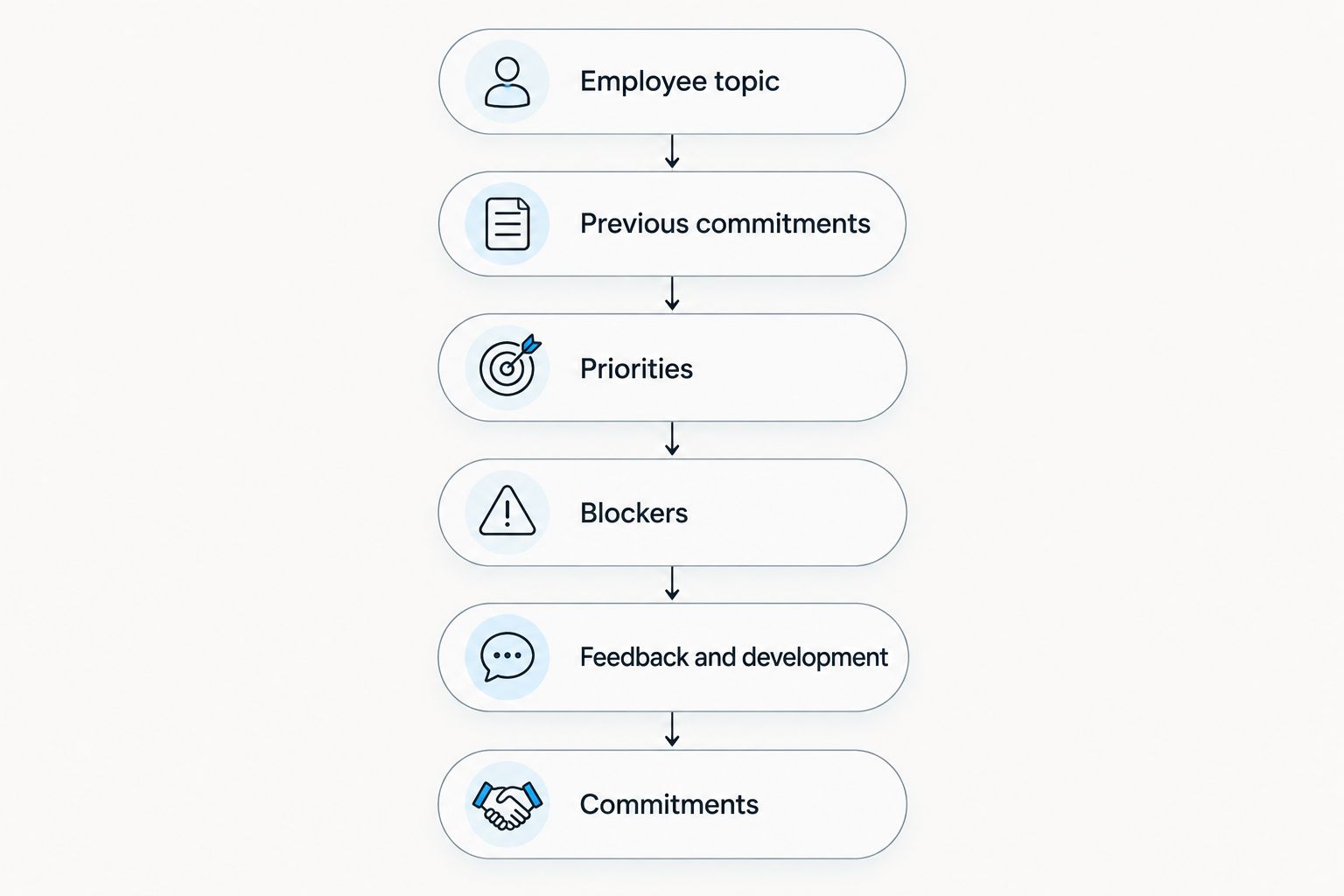
Use the following structure as a shared document, not a private manager checklist. The employee should be able to add topics before the meeting, correct the notes afterward, and see which commitments remain open.
Copyable manager–employee template
Meeting details
- Employee:
- Manager:
- Meeting date: [month and day], 2026
- Employee's opening topic:
- Manager's opening topic:
- Previous commitments to revisit:
Check-in
- How are things feeling at work?
- What deserves attention before we discuss the agenda?
- What would make this conversation useful for you?
Priorities and expectations
- What matters most before our next meeting?
- Which expectations need clarification?
- What should stop, move, or change?
Blockers and manager support
- What is getting in your way?
- Which decision or resource do you need from me?
- What have you already tried?
Feedback in both directions
- Employee feedback for the manager:
- Manager feedback for the employee:
- Specific situation or example:
- Change to try:
Development
- Skill or responsibility the employee wants to develop:
- Relevant opportunity:
- Support the manager will provide:
- How to recognize progress:
Close and follow-up
- Decision:
- Action:
- Owner:
- Due date:
- Completion condition:
- Topic to revisit next time:
Do not fill every field just to finish the form. If an employee raises a serious concern, give that concern the meeting rather than racing through the remaining headings.
How to run the conversation
- Open with the employee's topic. Ask what deserves attention, then let the employee finish. Avoid answering your own question or immediately defending a decision they mention.
- Review previous commitments. Check whether each action is complete, blocked, or no longer relevant. A changed priority needs an explicit decision, not a silently abandoned task.
- Clarify priorities. Ask what the employee believes matters most. If your expectations differ, settle the difference before discussing performance against those expectations.
- Work through blockers. Identify whether the obstacle requires advice, a decision, access, or action from you. Do not give encouragement when the employee needs authorization.
- Exchange feedback and discuss development. Use concrete situations and observable behavior. Separate immediate work corrections from longer-term career interests so neither topic disappears into the other.
- Read back the commitments. Confirm who owns each action, when it is due, and what completion means. Ask whether the notes reflect what both people actually agreed.
The sequence is a starting point, not a script. Keep the opening and closing, but move the middle sections to match the employee's needs.
Which questions should managers ask in a one-on-one?
Choose questions that match the problem in front of you. A long question bank is useful for preparation; reading it aloud is not.
Check-in questions
- What has been taking more energy than it should?
- What feels clear, and what feels uncertain?
- Is there something you have wanted to raise but have not found the right setting for?
- What would you like me to understand about your workload?
Treat these as invitations. Do not push an employee to share personal information to prove that the conversation is candid.
Priority and blocker questions
- Which task deserves attention first, and why?
- Where are you waiting on someone else?
- Which expectation is hardest to interpret?
- What decision do you need me to make?
- If we change this priority, what gets delayed?
These questions connect the conversation to choices. When everything sounds urgent, ask about trade-offs rather than telling the employee to manage time better.
Feedback questions
- What should I do differently to support your work?
- Was there a recent interaction where my expectations were unclear?
- Which part of our working relationship is helping you?
- What should we repeat or change after the last project?
Ask for examples before drawing conclusions. Feedback about a specific interaction gives you something to examine; a broad label such as unhelpful or disengaged does not tell you what happened.
Development questions
- Which responsibility would you like to grow into?
- What work would help you practice that skill?
- What support do you need to take it on?
- What would demonstrate progress without relying on a job title?
Do not promise a promotion to keep the conversation positive. Distinguish an opportunity you can provide from an outcome you cannot guarantee.
Why your one-on-one structure varies
The same agenda does not need the same emphasis every time. Adjust the discussion around these factors:
- Employee priorities. A concern about workload belongs ahead of a routine manager update.
- Open commitments. An unresolved decision needs attention before you add more actions to the list.
- Role clarity. Unclear expectations require clarification, not a performance judgment based on assumptions.
- Work obstacles. A blocked dependency calls for a different response than a skill-development request.
- Sensitivity. Personal, performance, or workplace concerns require deliberate choices about notes, access, and recording.
- Development goals. A career conversation needs space for interests and opportunities, not just current assignments.
The template stays consistent so you can find the record later. The conversation stays flexible so you can address the actual issue.
How do I prepare for a one-on-one with my employee?
Prepare a shared agenda, review your own unfinished commitments, and select the feedback that needs a conversation rather than an announcement. Ask the employee to add topics before the meeting, without making advance preparation a condition for raising a concern.
For your 2026 meeting records, use a consistent date format and keep previous actions visible. Bring examples when discussing work quality or behavior; do not rely on an impression you cannot explain.
Separate what you know from what you want to understand. If a deadline slipped, bring the deadline and outcome, then ask about the circumstances before deciding why it happened.
Preparation should make you more curious, not more certain. Arriving with a diagnosis for every problem leaves little room for the employee's account.
Should I use the same template for every employee?
Use the same core sections for every employee, but change the questions and emphasis. Shared headings make commitments easier to review; identical conversations ignore differences in responsibilities and concerns.
For an employee learning a role, focus on expectations, access, and useful feedback. For an employee seeking broader responsibility, spend more attention on decisions they can own and opportunities to practice.
Neither version needs a separate performance scorecard inside the agenda. If you need a formal evaluation, distinguish that process from the recurring support conversation.
How do I turn a one-on-one into clear follow-up?
Write each action as a specific commitment with an owner, a due date, and a completion condition. Keep discussion notes separate from decisions so an idea does not accidentally become an assignment.
For example, exploring a training opportunity is not the same as approving it. Your notes should distinguish the employee's interest, the manager's next action, and the decision still required.
Use status labels such as open, complete, blocked, or changed. If an action is blocked, identify what needs to happen next rather than carrying the same vague item into every meeting.
Manager commitments belong in the record too. If you promised a decision or an introduction, review that promise before asking why the employee has not progressed.
Should you take notes manually or record the conversation?
Choose the method around sensitivity, consent, and the record you need—not simply the amount of information you can capture. A short agreed summary can be the right choice even when a transcript is technically possible.
| Option | Best for | Useful output | Limitation |
|---|---|---|---|
| Manual shared notes | Sensitive conversations where recording is not appropriate | Selected decisions, context, and agreed actions | Someone must write and confirm the record |
| Omi | Managers who want conversation capture and generated follow-up | Transcripts, summaries, action items, tasks, and searchable memories | Generated output still needs review; recording requires consent and policy checks |
Omi is best for managers who want conversation transcripts and generated tasks without writing every note by hand. It captures spoken interactions through its wearable or through the phone or Mac app's built-in microphone. You do not need the wearable to use those app-based recording methods.
The benefit is a record you can revisit. The limit is equally important: a generated task does not prove that an employee accepted an assignment, and a summary does not replace checking what a sensitive statement meant.
Omi documentation, checked September 23, 2026, lists support for 33 languages, with English the most accurate. Set the language manually; the app does not automatically switch languages mid-conversation.
The Basic plan includes 300 listening minutes per month, while Plus includes 1,500 listening minutes per month. Every plan has the same core features, so choose a listening allowance around the conversations you intend to capture rather than expecting a different meeting workflow.
Before recording a 2026 one-on-one, explain the purpose, who will access the record, and how it will be handled. Consent rules vary by location; check local law and your employer's policy. This is not legal advice.
If recording is inappropriate or your employee is uncomfortable with it, use agreed written notes. Do not treat a request for an unrecorded conversation as evidence that someone has something to hide.
FAQ
What's the best one on one meeting template for a manager?
The best one on one meeting template covers the employee's concerns, priorities, blockers, feedback, development, and agreed actions. Keep it shared and adjust the emphasis to the conversation rather than filling every field.
How do I start a one-on-one meeting with an employee?
Start by asking what the employee wants to discuss and what would make the meeting useful. Let the employee finish before moving to your own topics.
Should a one-on-one meeting include project status updates?
Include project updates when they require a decision, clarification, or manager support. Keep routine reporting separate so it does not crowd out concerns and feedback.
What should I write down after a one-on-one?
Write down agreed decisions and actions with an owner, a due date, and a completion condition. Distinguish proposals from commitments and confirm that both people understand the record.
How do I ask an employee for feedback about my management?
Ask what you should do differently and request a specific recent example. Listen without immediately defending yourself, then agree on a change you can actually make.
Can I record a one-on-one meeting with my employee?
Check local consent law and workplace policy before recording a one-on-one. Explain the purpose and handling of the record, and use written notes when recording is not appropriate.
Can Omi capture meeting notes without its wearable?
Omi can record through the phone or Mac app's built-in microphone without the wearable. Review generated summaries and tasks before using them as the agreed meeting record.
One last thing
Before ending your next 2026 one-on-one, ask: What did I misunderstand today? It gives the employee a direct way to correct your interpretation before it becomes the official record.
Then check your own action list. A useful meeting does not just tell the employee what to do; it makes your responsibilities visible too.