How to write a meeting summary (template and examples)


In this article
To write a meeting summary, state the outcome first, then record decisions, action items, owners, deadlines, and unresolved questions. Use the meeting summary template below to turn your notes into a useful follow-up without rewriting the conversation or treating a suggestion as an agreement.
- Use this meeting summary template to separate decisions, action items, and open questions.
- Give each action item a named owner and an agreed deadline; flag missing details instead of inventing them.
- Omi suits professionals who want conversation transcripts, summaries, and tasks without manually capturing every spoken detail.
- Review the source before sharing: a proposed action is not an approved commitment.
How do you write a meeting summary?
Write a meeting summary around what changed and what happens next, not the order in which people spoke. Your reader should understand the result without attending the meeting or opening a transcript.
If your source notes are scattered, use these meeting note-taking techniques to capture decisions and commitments more clearly before drafting the follow-up.
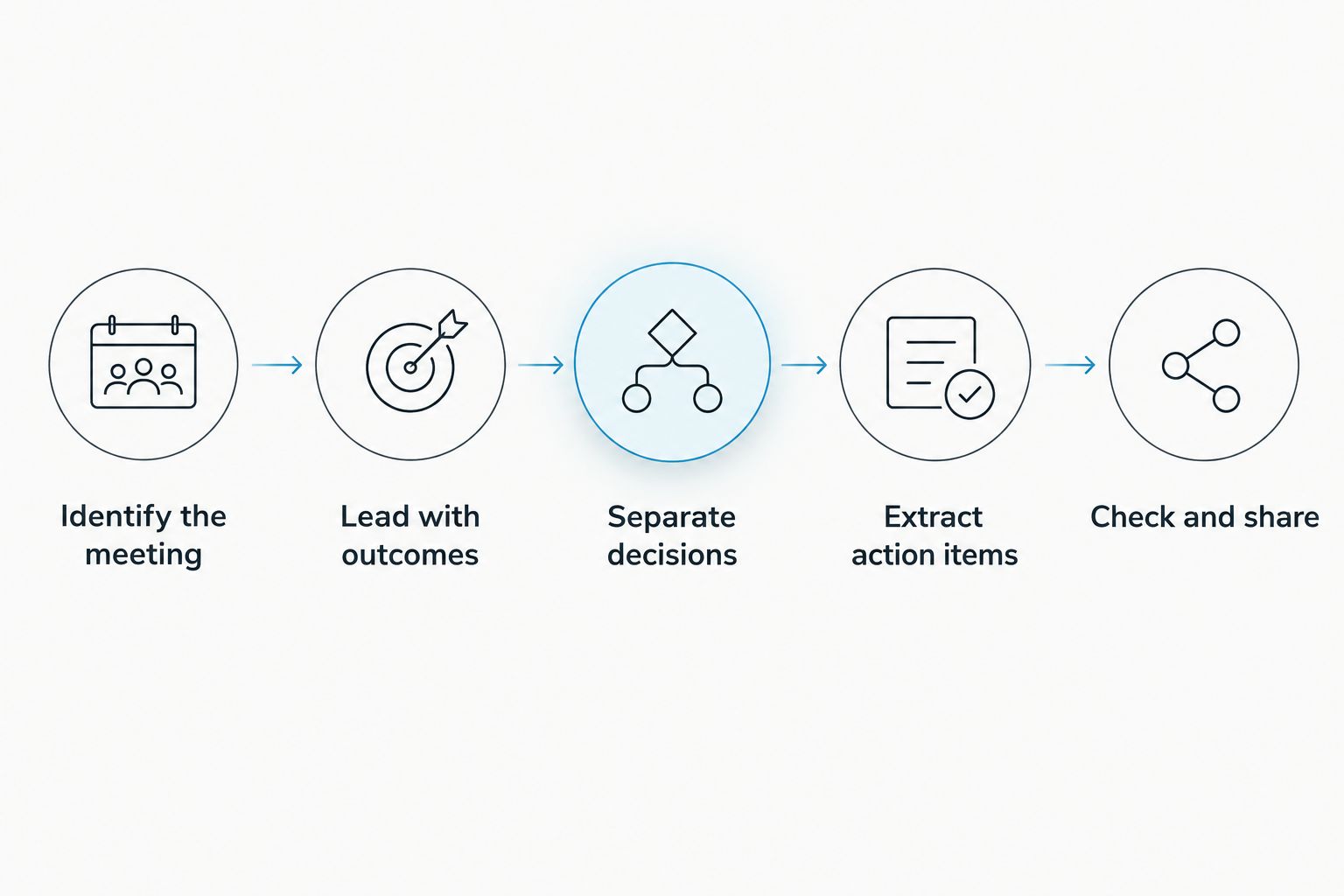
- Identify the meeting. Add its purpose, date, participants, and the person preparing the summary. Use a subject line that makes the discussion easy to find later.
- Lead with the outcome. State what the group decided, resolved, or left unresolved. If no decision was reached, say so directly.
- Separate decisions from discussion. Record approved choices under decisions. Keep proposals, objections, and background in supporting notes only when they explain the outcome.
- Extract action items. Write each task as a concrete deliverable. Name the owner and use the deadline agreed during the meeting.
- Check and share. Verify names, dates, commitments, and sensitive information against your notes or recording. Ask participants to correct disputed points rather than presenting uncertainty as fact.
Why this matters
A summary becomes the reference people use after the conversation ends. If it blurs a suggestion into a decision, the follow-up starts from the wrong premise.
A useful summary preserves accountability without pretending there was agreement. Write the result plainly, keep unresolved issues visible, and make it easy for the right person to correct the record. A polished paragraph is no substitute for an accurate owner or deadline.
Meeting summary template: copy and fill in
Use this template for a working meeting, project review, or internal discussion. Delete fields that do not apply, but keep decisions separate from open questions.
The sample date shows the format only. Replace it with the actual meeting date rather than the date you send the summary.
Meeting details
Meeting: Descriptive meeting name
Date: Month Day, 2026
Participants: Names and relevant roles
Prepared by: Summary author
Outcome
Write a short statement explaining what the meeting achieved. If the group did not reach a decision, identify what remains unresolved and what information is needed next.
Decisions
- Decision: State the agreed choice.
- Reason: Include the relevant constraint or rationale, if it was discussed.
- Scope: Explain what the decision covers and any explicit exclusions.
Action items
| Action | Owner | Due date | Dependency |
|---|---|---|---|
| Start with a verb and name the deliverable | Named person | Agreed date, or not agreed | Required input, or none identified |
Open questions and blockers
- Question or blocker: Describe the unresolved issue.
- Next step: State how the group agreed to resolve it.
- Responsible person: Name the person checking it, or mark ownership as unassigned.
Next checkpoint
Record the agreed review date or trigger. If the group did not schedule another meeting, write that no checkpoint was agreed rather than adding one yourself.
Meeting summary examples
The examples below are fictional writing samples, not reports of real meetings or business results. They show how the same structure works when a meeting ends with a decision, a dependency, or no agreement.
Project review: record the decision and its boundary
Meeting: Website content review
Date: October 6, 2026
Participants: Maya, content lead; Jordan, designer
Outcome: The team approved the revised page outline. Publication remains dependent on reviewing the final copy.
Decisions: Keep the customer questions section. Remove the duplicated introduction. Approval applies to the outline, not the finished page.
Action items: Maya will revise the copy by October 8, 2026. Jordan will review the layout after receiving the revised text; the layout review deadline was not agreed.
Open question: The team still needs to confirm who approves the final page.
This example distinguishes approval of an outline from approval to publish. That boundary belongs in the summary because it changes what the team is authorized to do next.
Client follow-up: make the dependency visible
Meeting: Client discovery discussion
Date: October 12, 2026
Participants: Account lead and client operations lead
Outcome: The discussion identified reporting requirements, but the client did not approve a proposed scope.
Decisions: Use the client's current reporting process as the starting point for the next discussion.
Action items: The client operations lead will share an example report. The account lead will prepare follow-up questions after receiving it. Neither deadline was agreed.
Open question: The client needs to identify the person responsible for scope approval.
The useful detail is the dependency: follow-up questions come after the example report. Do not replace that sequence with a deadline nobody accepted.
Unresolved discussion: say that no decision was reached
Meeting: Support handoff review
Date: October 15, 2026
Outcome: No handoff process was approved. Participants disagreed about when ownership should transfer between teams.
Decisions: None recorded.
Action items: Each team lead will document the current handoff process before the next review. The review date remains unconfirmed.
Open question: Who owns a request while the receiving team checks whether it has enough information?
A meeting without agreement still needs a summary. Preserve the disagreement and the next step; do not manufacture a shared position to make the meeting sound productive.
Why meeting summaries vary
Keep the core structure stable, then adjust the detail to match the record you actually need. These factors determine what deserves space:
- Purpose: A decision meeting needs a clear outcome. A discovery discussion needs confirmed requirements and unanswered questions.
- Audience: Attendees need commitments; absent stakeholders also need enough context to understand the decision.
- Decision status: Approved, proposed, deferred, and rejected are different outcomes. Use the right label.
- Dependencies: Show when a task cannot start until someone supplies information or completes another action.
- Sensitivity: Exclude personal or confidential details that recipients do not need for the follow-up.
- Record requirements: A working recap does not replace formal minutes where your organization requires them.
Is a meeting summary the same as meeting minutes?
A meeting summary emphasizes outcomes and follow-up; meeting minutes serve as a more structured record of proceedings. A transcript preserves spoken wording, which makes it useful for checking details but different from either finished document.
Choose the record your audience needs. Do not send a transcript merely because it contains everything.
| Record | Best for | Strength | Limitation |
|---|---|---|---|
| Meeting summary | Day-to-day team follow-up | Makes decisions and responsibilities easy to scan | Leaves out much of the discussion |
| Meeting minutes | Meetings requiring a structured record | Preserves proceedings in the required format | Needs more procedural detail than a short recap |
| Transcript | Checking wording and context | Provides a source for reviewing what was said | Requires review to identify actual decisions |
For formal proceedings, follow your organization's required format and approval process. A concise recap can accompany that record, but it should not silently replace it.
How do you turn meeting notes into action items?
Turn meeting notes into action items by extracting commitments, not every sentence containing a future-tense verb. A useful task names a deliverable and identifies who accepted responsibility for it.
Replace vague wording such as follow up on reporting with a concrete action such as send the current reporting requirements to the project lead. Keep the owner separate from the people who merely discussed the issue.
Never infer a deadline from urgency. If someone says an issue needs attention soon, record the deadline as unconfirmed and ask for clarification. Likewise, if a group discusses a task without assigning it, mark the owner as unassigned.
Read the final task list on its own. Every item should still make sense without the conversation around it, including any dependency that prevents work from starting.
Can you use a recording to draft a meeting summary?
A recording or transcript can provide source material for a meeting summary, but the draft still needs review. Check the passages containing decisions, names, dates, objections, and commitments before sharing them as settled facts.
Omi is best for professionals who want conversation transcripts, summaries, and tasks in one place. The Omi wearable captures what you say and hear, while the companion app produces transcripts, summaries, action items, and memories. You can also record with the phone or Mac app without the wearable.
Omi supports 33 languages, with English the most accurate. Set the language manually: it does not automatically switch languages mid-conversation. That limitation matters when reviewing multilingual meeting notes.
For online meetings, Omi records through the Mac app or through a phone or wearable in the room; it does not join as a meeting bot. Recording access does not replace consent: rules vary by location, so check local law before recording.
Use generated text as a draft, not proof that everyone agreed. Compare important commitments with the source and remove sensitive material that does not belong in the shared summary.
FAQ
What should a meeting summary include?
A meeting summary should include the meeting purpose and date, the outcome, decisions, action items, owners, deadlines, and unresolved questions. Keep background only when it explains an outcome or dependency.
How do I start a meeting summary email?
Start a meeting summary email with the outcome, then list decisions and next steps. Use a descriptive subject line and include the meeting date so readers can identify the discussion.
How long should a meeting summary be?
A meeting summary should be as short as possible while preserving decisions, responsibilities, deadlines, and necessary context. Remove repeated discussion before removing details that affect what someone must do.
What if nobody agreed on a deadline?
Mark the deadline as not agreed or unconfirmed. Ask the task owner to confirm it instead of presenting an assumed date as a meeting commitment.
Can I send a transcript instead of a meeting summary?
A transcript is not a substitute for an outcome-focused summary. Use it as supporting source material when appropriate, and provide a separate recap of decisions, tasks, and open questions.
Should a meeting summary include disagreements?
Include disagreements when they explain an unresolved decision, an objection, or a condition affecting the next step. Describe the issue neutrally rather than assigning motives to participants.
How do I correct a meeting summary after sending it?
Send a clearly identified correction stating what changed and which decision or action item it affects. Update the shared record so recipients do not have to reconcile conflicting versions.
One last thing
Before sending, search your draft for words such as agreed, approved, and will. Check each against your source notes.
Those words turn discussion into commitment. If the source does not support them, change the wording to proposed, discussed, or not yet confirmed. A summary earns trust by preserving uncertainty, not editing it away.