How to write board meeting minutes (with a template)


In this article
Write board meeting minutes by recording attendance, the board’s decisions, motion wording, vote outcomes, and assigned actions—not every spoken sentence. Use the board meeting minutes template below to organize that record, then verify it against your notes and submit it through your board’s approval process. A recording or transcript supports the draft; it does not replace approved minutes.
- Use this board meeting minutes template to separate decisions, votes, and action items from discussion.
- Record exact motion wording and confirmed outcomes; never reconstruct a vote from conversational agreement.
- Omi suits board secretaries who want searchable conversation notes to support—not replace—reviewed minutes.
- Keep drafts clearly marked and follow your board’s approval, access, and retention procedures.
Why this matters
Minutes record what the board did. A transcript records what people said. Confusing the two produces a long document that can still leave the actual decision unclear.
Your reader should be able to find the adopted resolution, its outcome, and any follow-up without searching through conversational detail. Keep working notes separate from the formal record. For the broader drafting workflow, see how to write meeting minutes.
For your 2026 board records, consistency matters more than elaborate formatting. Use the same headings each time, identify drafts plainly, and make the approval status visible. This is drafting guidance, not legal advice; your organization’s governing documents and applicable requirements control the record you need.
How to write board meeting minutes with a template
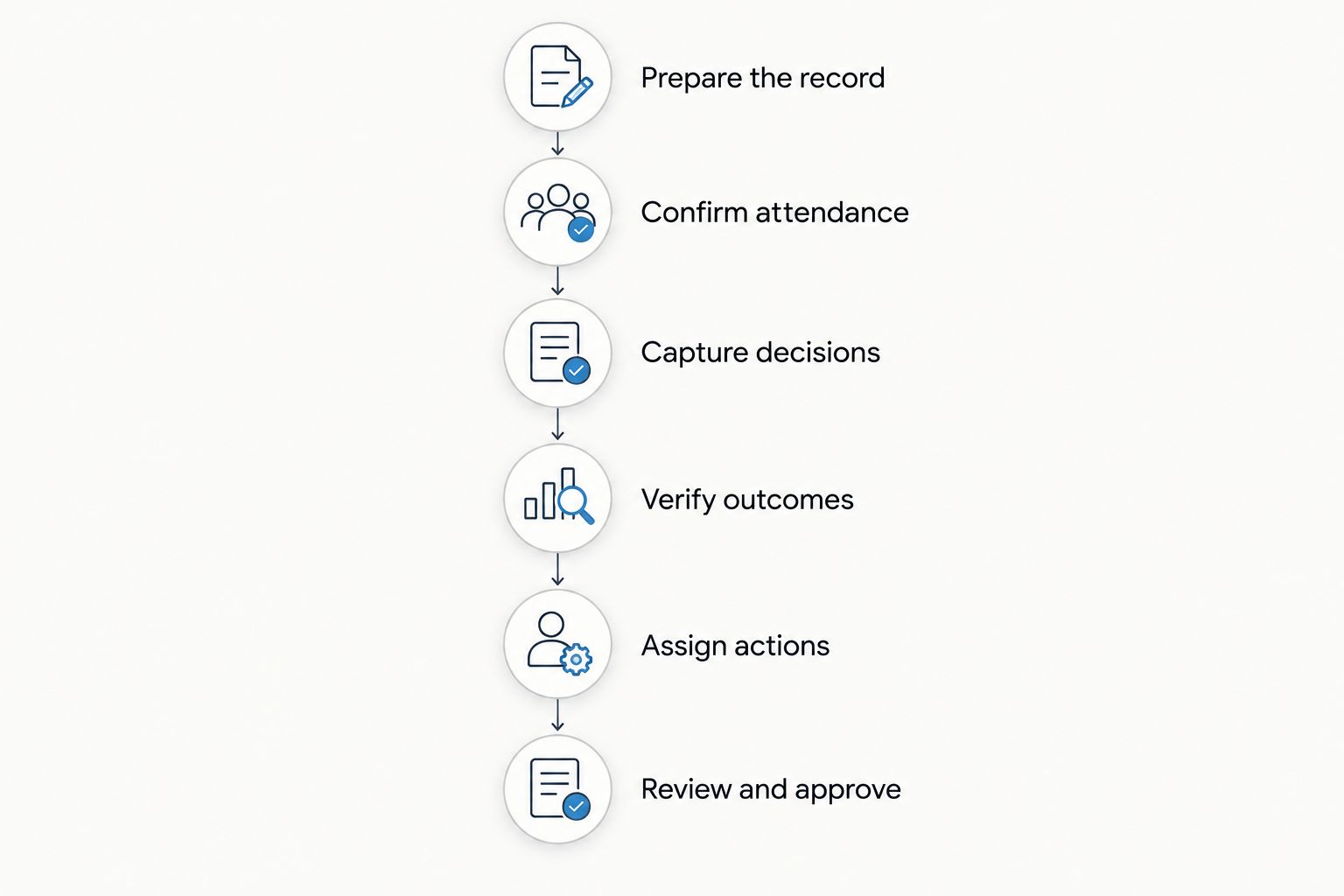
Use these 6 steps to turn an agenda and meeting notes into a reviewable record. Start before the meeting so you can spend the discussion listening rather than building a document from scratch.
1. Prepare the record
Copy the agenda headings into your draft. Add the organization name, meeting type, date, location or meeting format, and spaces for attendance and approval status.
Check your board’s procedures for quorum, voting, conflicts, and minutes approval before you begin. Leave unanswered fields blank. An agenda tells you what the board plans to discuss, not what it eventually decides.
2. Confirm attendance
Record directors present and absent separately from guests and staff. Note the chair and the person preparing the minutes.
Record quorum as confirmed under the board’s governing rules; do not infer it from how full the room looks. Track arrivals or departures when they affect participation in a decision. For remote meetings, verify names instead of relying only on a display name.
3. Capture decisions
For each agenda item, distinguish a report, discussion, motion, and decision. Copy formal motion or resolution wording accurately, including amendments that change the final text.
Record the mover and seconder where your board’s procedure requires them. If wording is unclear, ask for it to be repeated or provided in writing. Never turn a suggestion into an adopted resolution.
4. Verify outcomes
Record whether a motion was adopted, rejected, withdrawn, deferred, or otherwise disposed of. Include the vote method and tally where recorded or required by your board’s process.
Distinguish votes against, abstentions, recusals, and absence. These are not interchangeable. Do not write that a decision was unanimous unless the outcome was confirmed as unanimous.
5. Assign actions
Separate the formal decision from the work needed to carry it out. Record the responsible person or role, the agreed deliverable, and the deadline actually set.
If the board did not assign an owner or deadline, flag that gap for clarification. Do not supply one yourself. Refer to supporting reports or papers using their actual titles and versions rather than reproducing the entire document.
6. Review and approve
Check names, dates, motion wording, outcomes, and assignments against your source material. Send the draft through the board’s designated review and approval process.
Keep corrections traceable and mark the final record according to your organization’s procedure. Do not silently replace approved minutes with a revised draft. Approval and correction practices belong to the board, not the note-taking software.
Board meeting minutes template for 2026
Copy this structure into your document. Replace blank fields with confirmed information, remove sections that do not apply, and preserve any additional fields your board requires. A blank field is safer than an invented detail.
Meeting details
- Organization: ____________________
- Governing body or committee: ____________________
- Meeting type: ____________________
- Meeting date: ____________________, 2026
- Location or remote meeting format: ____________________
- Chair: ____________________
- Minutes prepared by: ____________________
- Status: Draft / approved, as applicable
Attendance and opening
- Directors present: ____________________
- Directors absent: ____________________
- Guests and staff present: ____________________
- Relevant arrivals or departures: ____________________
- Quorum confirmation: ____________________
- Meeting called to order at: ____________________
Record participation changes beside the affected agenda item if that makes the decision record clearer. Keep guests distinct from voting members.
Previous minutes and agenda
- Previous minutes considered: ____________________
- Corrections approved, if any: ____________________
- Approval outcome: ____________________
- Agenda changes agreed, if any: ____________________
Do not mark previous minutes as approved simply because they appeared on the agenda. Record the actual outcome of their consideration.
Agenda item record
Repeat this section for each substantive item:
- Agenda item title: ____________________
- Report or supporting paper considered: ____________________
- Brief discussion context, if needed: ____________________
- Final motion or resolution wording: ____________________
- Moved by, where required: ____________________
- Seconded by, where required: ____________________
- Amendments and their disposition: ____________________
- Vote method and recorded result: ____________________
- Abstentions, recusals, or dissent recorded under board procedure: ____________________
- Decision or disposition: ____________________
- Follow-up action: ____________________
- Responsible person or role: ____________________
- Agreed deadline: ____________________
Keep a discussion-only item distinct from an item that produced a decision. If consideration was deferred, record that outcome and any agreed next step.
Closing and approval
- Other business considered: ____________________
- Next meeting details, if agreed: ____________________
- Meeting adjourned at: ____________________
- Referenced papers or attachments: ____________________
- Draft reviewed by: ____________________
- Approval date and recorded corrections: ____________________
- Signature or authentication, where required: ____________________
Use your organization’s required approval wording. A reviewer checking spelling is not necessarily the same as the board approving the minutes.
What belongs in minutes, notes, and transcripts?
Keep 2 separate records when using capture tools: working material and the formal minutes. Your working material can include notes and a transcript; the approved minutes should remain identifiable as their own document.
| Record | Best for | Strength | Limitation |
|---|---|---|---|
| Working notes | The person drafting minutes | Quickly capture decisions, questions, and follow-up | Shorthand can omit context or exact wording |
| Transcript | Checking what was said | Provides spoken detail for verification | Can contain recognition errors and unnecessary sensitive detail |
| Board minutes | Recording board business | Organizes decisions, outcomes, and responsibilities | Requires review; is not a verbatim account |
Include enough context to make a decision understandable without reproducing every argument. For example, a report’s title and the board’s response are clearer than a paragraph following each speaker’s remarks.
Treat sensitive discussion according to your board’s procedures. Do not assume that confidential material belongs in a broadly circulated draft, or that leaving it out resolves a recordkeeping obligation. Ask the designated governance lead how the organization handles restricted records.
Why board meeting minutes vary
The template stays useful across meetings because you can adjust the detail without changing its purpose. These factors determine what you must verify before drafting:
- Governing documents: Your board’s rules determine quorum, approval procedures, and required recording details.
- Business conducted: A report-only item needs a different entry from a motion that was amended and voted on.
- Participation changes: Arrivals, departures, and recusals can affect who participated in a decision.
- Meeting format: Remote or hybrid participation requires careful identification of speakers and voters.
- Sensitivity: Restricted discussions require the organization’s established handling and access process.
- Supporting papers: Exact document titles help distinguish what was considered from what was adopted.
For a 2026 template refresh, check these requirements before changing the layout. A prettier document does not fix an incorrect decision record.
Can a recording tool write board meeting minutes for you?
A recording tool can support drafting, but the board’s designated reviewer still needs to verify the formal record. Omi is best for board secretaries who want searchable conversation notes to support reviewed minutes.
Omi is a wearable note-taking device with a companion app that produces transcripts, summaries, action items, and memories. You can also record with the phone or Mac app without the wearable. For online meetings, the Mac app records without joining as a meeting bot.
The advantage of Omi note-taking is access to conversation material you can search and check. The limitation is governance: generated summaries and tasks do not establish that a motion passed, that a quorum existed, or that the board approved the minutes. Verify those facts separately.
Before using a recording workflow in 2026, obtain the permissions your organization requires. Consent rules vary by location; check local law. Confirm access and retention arrangements before capturing confidential board discussions, and do not treat an export or deletion feature as a substitute for a records policy.
How much discussion should board minutes include?
Include the context needed to understand the board’s action, not a speaker-by-speaker recap. Lead with the issue considered, then record the formal outcome and any agreed follow-up.
Keep neutral language. Avoid describing a debate as heated, a proposal as excellent, or a director as difficult. Those judgments do not clarify what the board decided.
What should you do when a vote is unclear?
Clarify an unclear vote during the meeting whenever possible. Ask the chair to confirm the motion wording, the voting outcome, and any participation issue that affects the record.
If uncertainty remains after the meeting, flag it in the draft for the designated reviewer. A transcript can help verify spoken words, but it cannot authorize you to invent a tally or interpret silence as agreement.
Check the draft in 3 review passes
For your 2026 minutes, separate fact-checking from editing. That keeps a polished sentence from disguising an unverified decision.
- Decision pass: Match each motion to its final wording and confirmed disposition. Check amendments, voting results, and participation changes.
- Action pass: Match each assignment to the person or role responsible, the deliverable, and the deadline actually agreed.
- Record pass: Check attendance, document references, approval status, access handling, and the distinction between draft and approved versions.
Read the action list against the decisions before circulation. A task generated from someone’s suggestion is not automatically an assignment authorized by the board.
FAQ
What’s the best board meeting minutes template for a small board?
The best board meeting minutes template records attendance, quorum confirmation, decisions, vote outcomes, and assigned actions in a repeatable format. Adapt the fields to your governing documents rather than adding detail simply to make the minutes longer.
Should board meeting minutes include everything people say?
Board meeting minutes should not reproduce everything people say. Record the board’s business and outcomes, adding only the discussion context needed to make the record understandable.
Do I need to record who moved and seconded a motion?
Record the mover and seconder when your board’s procedures require those details. Confirm the applicable practice before the meeting instead of assuming every board uses the same format.
Can Omi help me prepare board meeting minutes?
Omi can help you prepare board meeting minutes with transcripts, summaries, action items, and search. A designated reviewer still needs to verify motion wording, vote outcomes, and the approval status of the formal minutes.
Can I record a board meeting without asking everyone?
Do not assume you can record a board meeting without permission. Consent rules vary by location; check local law and your organization’s recording and confidentiality policies before recording.
How do I correct board meeting minutes after approval?
Correct approved board meeting minutes through your board’s established correction process. Keep the change traceable rather than silently overwriting the approved record.
Should a transcript be attached to the board minutes?
A transcript does not need to be attached merely because it exists. Follow your organization’s requirements for attachments, access, and retention, keeping the formal minutes distinct from working material.
One last thing
Check the verbs. Discussed, proposed, approved, and assigned describe different events. Before filing the minutes, confirm that each decision sentence uses the verb the meeting actually supports.
This is a useful final check for your 2026 records: if a reader cannot tell what changed because the board met, the draft needs another decision pass—not another page of discussion.