One Party Consent States: Check Before Recording | 2026


In this article
In one party consent states, a participant generally can record a conversation without getting permission from everyone else; all-party rules generally require every participant’s consent. In 2026, the distinction still depends on the state, the communication type, and whether the conversation is private. For interstate calls or sensitive workplace conversations, check the applicable law before recording—your location alone does not settle the question.
- One party consent states generally allow a participant to record; they do not authorize an outsider to intercept conversations.
- California and Florida generally require all-party consent for protected conversations; communication type and exceptions still matter.
- Interstate recording requires checking participants’ locations, not just the recorder’s home state.
- Omi captures conversations and creates notes; recording features do not replace consent or workplace authorization.
Which states are one party consent states in 2026?
Most states generally follow a one-party approach, but a state label is not permission to record every conversation. The federal baseline, 18 U.S.C. § 2511(2)(d), generally permits recording by a participant or with a participant’s prior consent, subject to its criminal-or-tortious-purpose exception. State law can impose additional restrictions.
The United States has 50 states. The following overview separates general one-party rules from all-party rules and states that need closer attention. It addresses ordinary conversation recording, not every surveillance, employment, healthcare, or public-recording issue.
| Rule category | States | What the label means |
|---|---|---|
| Generally one-party | Alabama, Alaska, Arizona, Arkansas, Colorado, Georgia, Hawaii, Idaho, Indiana, Iowa, Kansas, Kentucky, Louisiana, Maine, Minnesota, Mississippi, Missouri, Nebraska, New Jersey, New Mexico, New York, North Carolina, North Dakota, Ohio, Oklahoma, Rhode Island, South Carolina, South Dakota, Tennessee, Texas, Utah, Vermont, Virginia, West Virginia, Wisconsin, Wyoming | A participant generally can record, subject to applicable exceptions and other laws. Vermont does not have a general state wiretapping statute equivalent to those in many other states. |
| Generally all-party for protected conversations | California, Florida, Illinois, Maryland, Massachusetts, New Hampshire, Pennsylvania, Washington | Do not treat your own participation as sufficient authorization. Privacy, secrecy, statutory exceptions, and the way consent is established matter. |
| Requires a closer communication-specific check | Connecticut, Delaware, Michigan, Montana, Nevada, Oregon | Telephone rules, in-person rules, notification requirements, civil liability, or statutory interpretation complicate a simple label. |
Washington, D.C., generally follows a one-party rule. It is separate from the state list.
Use this overview to identify what to check, not as a substitute for the applicable statute or legal advice. If recording is inappropriate, use written notes instead; this guide to how to take meeting notes covers that alternative.
One-party versus all-party: what actually changes?
The difference is whose permission is necessary—not whether your device can capture audio. A person outside the conversation does not become an authorized recorder simply because the conversation happens in a one-party state.
| Approach | Permission baseline | Best for | Benefit | Limitation |
|---|---|---|---|---|
| One-party consent | A participant’s consent generally suffices | Understanding participant-recording rules where applicable | Does not generally require separate permission from every speaker | Participation does not remove statutory exceptions or other restrictions |
| All-party consent | Every participant’s consent is generally required for protected conversations | Planning recordings involving private conversations in all-party jurisdictions | Establishes permission across the conversation | Consent must satisfy the applicable law; silence is not a universal substitute |
| Written notes without audio | No audio recording takes place | Meetings where recording permission is unavailable | Avoids making an audio recording | Confidentiality, workplace, and professional duties still apply |
Why this matters
A recorder captures more than the sentence you wanted to remember. It can capture a client’s confidential information, a colleague’s private aside, or someone who never agreed to participate in a recorded meeting.
Consent to recording and permission to use the recording are separate questions. A lawful recording does not automatically authorize uploading it, sharing a transcript, or keeping it indefinitely. In 2026, your recording workflow needs to address both capture and subsequent handling.
For business use, resolve permission before the meeting starts. Discovering a restriction after transcription leaves you managing audio, notes, tasks, and exports that already exist.
What does one-party consent allow?
One-party consent generally allows you to record a conversation in which you participate, where the applicable law permits it. Your own consent supplies the required participant consent; you do not need to manufacture a separate consenting person.
That does not authorize leaving a recorder behind to capture a conversation after you leave. Nor does it authorize accessing another person’s calls or placing recording equipment where you have no lawful right to intercept communications.
Federal law also includes a criminal-or-tortious-purpose exception. A recording intended for an unlawful purpose does not become lawful merely because the recorder participated.
Treat one-party consent as a permission rule, not a blanket exemption. Workplace policies, confidentiality obligations, professional duties, and restrictions on particular locations or information require separate attention.
What does two-party consent mean when more people join?
Two-party consent is a common name for all-party consent. It does not mean that permission from 2 participants is enough when 3 participants are speaking; the relevant requirement generally extends to everyone involved in the protected conversation.
California Penal Code § 632 addresses confidential communications. Florida Statutes § 934.03 and Pennsylvania’s Wiretapping and Electronic Surveillance Control Act also establish consent requirements, with statutory exceptions that need separate review.
Other states frame the issue differently. Massachusetts General Laws chapter 272, § 99 focuses on secret interception, while Illinois law addresses private conversations. These differences explain why a single colored map cannot answer every recording question.
For an all-party workflow, obtain agreement before recording and revisit permission when someone new joins. Do not assume that a calendar invitation, visible microphone, or generic meeting notice satisfies every jurisdiction’s requirements.
Which states need a closer check?
The difficult states are not interchangeable. For a 2026 recording decision, identify the communication type and the specific legal issue before relying on a label.
Connecticut: telephone recording can create civil liability
Connecticut’s criminal eavesdropping provisions and its civil telephone-recording statute do not use an identical framework. Connecticut General Statutes § 52-570d establishes requirements concerning telephone recording, with exceptions.
Do not use a criminal-law summary alone to decide whether recording a telephone call is lawful. Civil exposure belongs in the same review.
Nevada and Oregon: distinguish calls from in-person conversations
Nevada treats wire communications and private in-person conversations under different provisions, including NRS §§ 200.620 and 200.650. Its telephone-recording rules also require attention to judicial interpretation.
Oregon’s ORS § 165.540 distinguishes telecommunications from other conversations, and litigation affecting recording restrictions makes current legal guidance important. Do not carry a telephone-recording answer into an in-person meeting without checking it.
Delaware and Michigan: a simple label misses interpretation
Delaware has both interception and privacy provisions, including 11 Del. C. §§ 2402 and 1335. Their interaction makes a generic one-party label an inadequate basis for private recording.
Michigan’s eavesdropping law, MCL § 750.539c, requires attention to how courts distinguish participants from third-party eavesdroppers. Check the rule for your actual role rather than relying on the word consent alone.
Montana: notification matters
Montana’s MCA § 45-8-213 addresses recording conversations and includes notification language and exceptions. Notification and affirmative consent are not identical concepts.
Use the statute’s actual requirements. Do not assume that a one-party/all-party chart fully describes Montana’s rule.
Why recording requirements vary
The recording device is rarely the decisive distinction. These factors change the legal question:
- Participant location: An interstate call connects people in different jurisdictions. Check every relevant location rather than choosing the least restrictive rule.
- Communication type: Telephone calls, electronic communications, and in-person conversations can fall under different provisions.
- Privacy or secrecy: Some statutes protect confidential or private conversations; others focus on secret interception.
- Your role: Participating in a conversation differs from recording other people’s conversation as an outsider.
- Purpose and exceptions: Unlawful purposes and statutory exceptions can change the result under the applicable law.
- Professional context: Workplace rules and confidentiality duties can restrict recording or subsequent use independently of consent law.
For your 2026 recording policy, document these factors separately. A state name alone leaves too much of the decision unresolved.
How do you prepare to record a conversation?
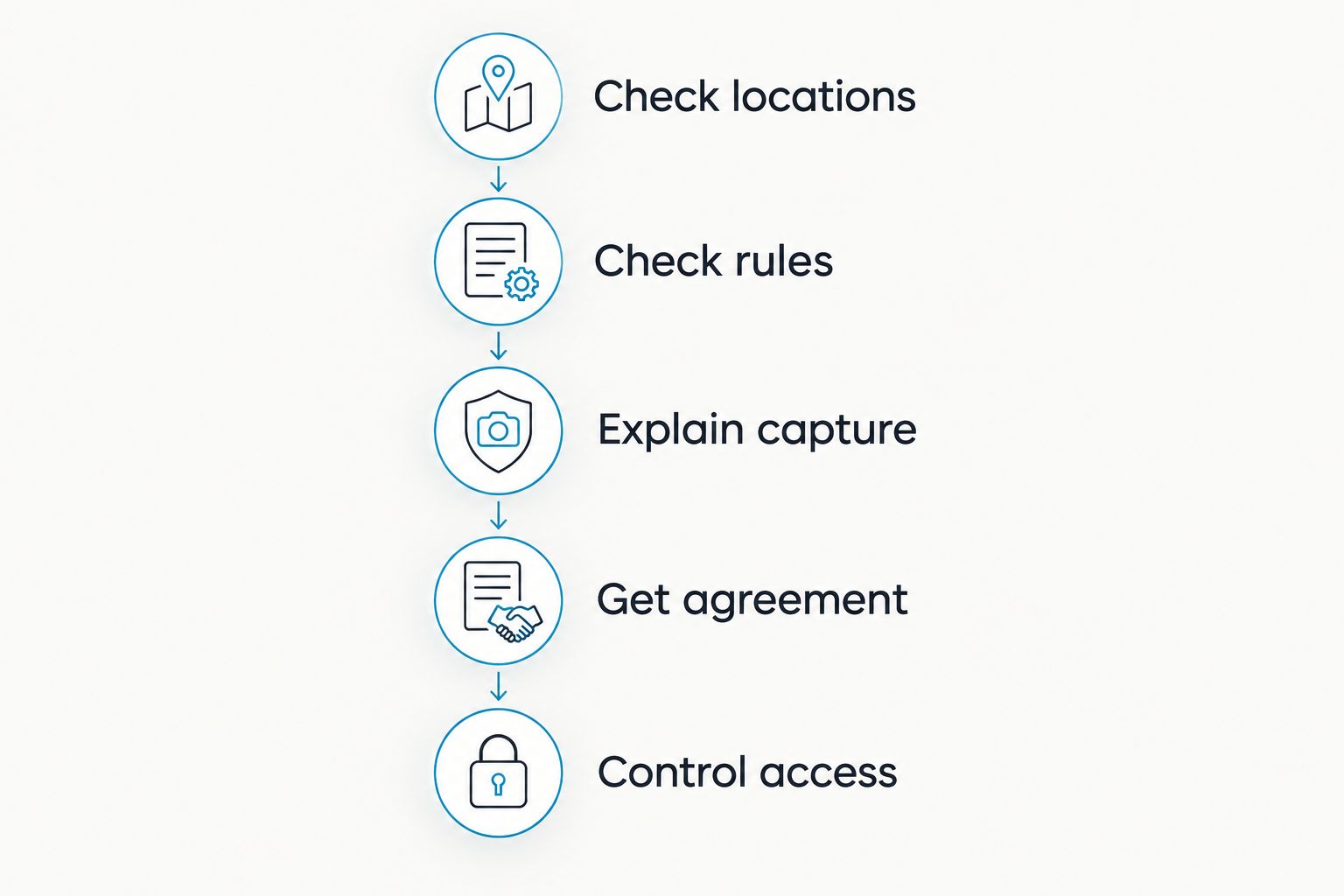
Use this sequence before activating a phone recorder, meeting app, or wearable. If you cannot establish permission, take written notes instead. These steps organize the decision; they do not replace legal advice.
- Check locations. Identify where the participants are physically located. For remote meetings, do not assume that an employer’s address tells you where each person is joining from.
- Check rules. Review the relevant recording law and organizational policy. For interstate or sensitive conversations, get qualified legal guidance rather than selecting a convenient state rule.
- Explain capture. Tell participants whether you intend to record audio, create a transcript, generate notes, or share the results. Do not describe recording as ordinary note-taking if audio is being captured.
- Get agreement. Establish consent in a manner appropriate to the applicable law. If someone declines, use a non-recording alternative; if someone joins later, address permission before continuing.
- Control access. Decide who can access the audio and outputs, where they will be stored, and when they will be deleted. Permission to capture is not unlimited permission to distribute.
This sequence makes the recording decision explicit. It also prevents a technical feature from silently becoming your organization’s privacy policy.
Where does a wearable recorder fit?
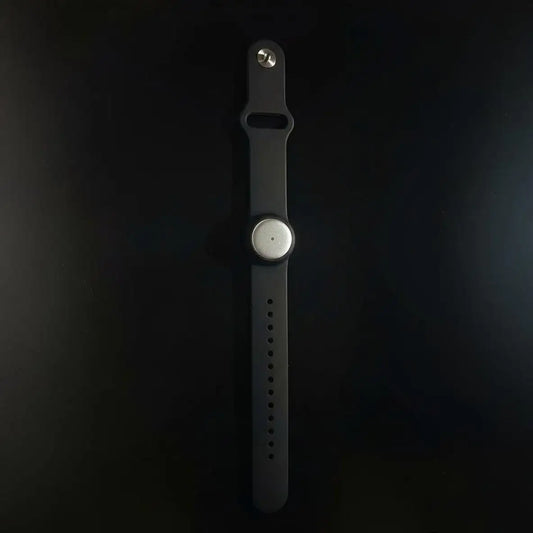
Omi is best for professionals who want spoken conversations turned into searchable notes and tasks after recording permission is settled. The Omi wearable captures what you say and hear, and its companion app produces transcripts, summaries, action items, and memories.
The benefit is practical: you can review captured conversations rather than relying only on handwritten notes. The limitation is equally practical: a wearable does not establish consent, distinguish permitted from prohibited conversations for you, or replace organizational approval.
Omi supports full export and deletion of individual items or everything. Those controls help you handle captured information, but they do not correct an unlawful recording. Set the boundary before capture, not after a useful summary appears.
Can you record someone without telling them in a one-party state?
A participant generally can record without notifying everyone else where the applicable one-party law permits it. That answer changes if another jurisdiction applies, a statutory exception intervenes, or workplace and professional restrictions prohibit the recording.
Do not confuse legally permitted with appropriate for every relationship. For a client or team workflow, explicit notice makes the recording arrangement clear even where separate permission from everyone is not legally required.
Which state’s law applies to an interstate call?
An interstate call does not automatically follow only the recorder’s state law. The applicable-law analysis depends on the jurisdictions and circumstances, so your home state’s one-party rule is not a reliable shortcut.
Obtaining everyone’s agreement is a practical conservative workflow, not a guarantee that every legal requirement is satisfied. Check local law and get qualified guidance for recurring interstate recording.
Does recording in public remove the consent requirement?
Being in public does not automatically resolve every recording question. Privacy expectations, whether recording is secret, the type of communication, and other applicable restrictions still matter.
Avoid treating a restaurant, hallway, or shared workplace as unrestricted recording territory. Your device can capture nearby speech that is unrelated to the conversation you intended to document.
FAQ
What are one party consent states?
One party consent states generally allow a conversation participant to record with that participant’s consent, subject to exceptions. They do not generally authorize an outsider to intercept other people’s conversations.
Is two-party consent the same as all-party consent?
Two-party consent commonly means all-party consent, including when more than 2 people participate. The applicable law determines whose consent is required and how it can be established.
Is California a one-party consent state in 2026?
California generally requires all-party consent to record confidential communications under Penal Code § 632. Privacy and statutory exceptions matter, so check the law for the specific conversation.
Can I record a call if I am in a one-party state?
Your location alone does not establish that recording the call is lawful. Check the other participants’ locations, applicable state laws, and any workplace or professional restrictions.
Does a meeting recording announcement count as consent?
A recording announcement is not a universal substitute for legally sufficient consent. Whether notice and continued participation satisfy the requirement depends on the applicable law and circumstances.
Does Omi get recording consent for me?
Do not treat Omi as a substitute for obtaining recording permission. You must check applicable law and establish the necessary consent before capturing the conversation.
Can I share a transcript if recording was lawful?
A lawful recording does not automatically authorize sharing its transcript. Confidentiality, organizational policy, and privacy obligations can independently restrict access and disclosure.
One last thing
Audit the outputs, not just the microphone. A conversation recorder can produce a transcript, summary, task, and exported file from the same interaction; deleting one output does not establish that every copy is gone.
Before your next recorded meeting in 2026, decide who needs each output and who does not. A narrow access policy is more useful than collecting permission and then distributing the transcript without a plan. This page provides general information, not legal advice; consent rules vary by location, so check local law.